

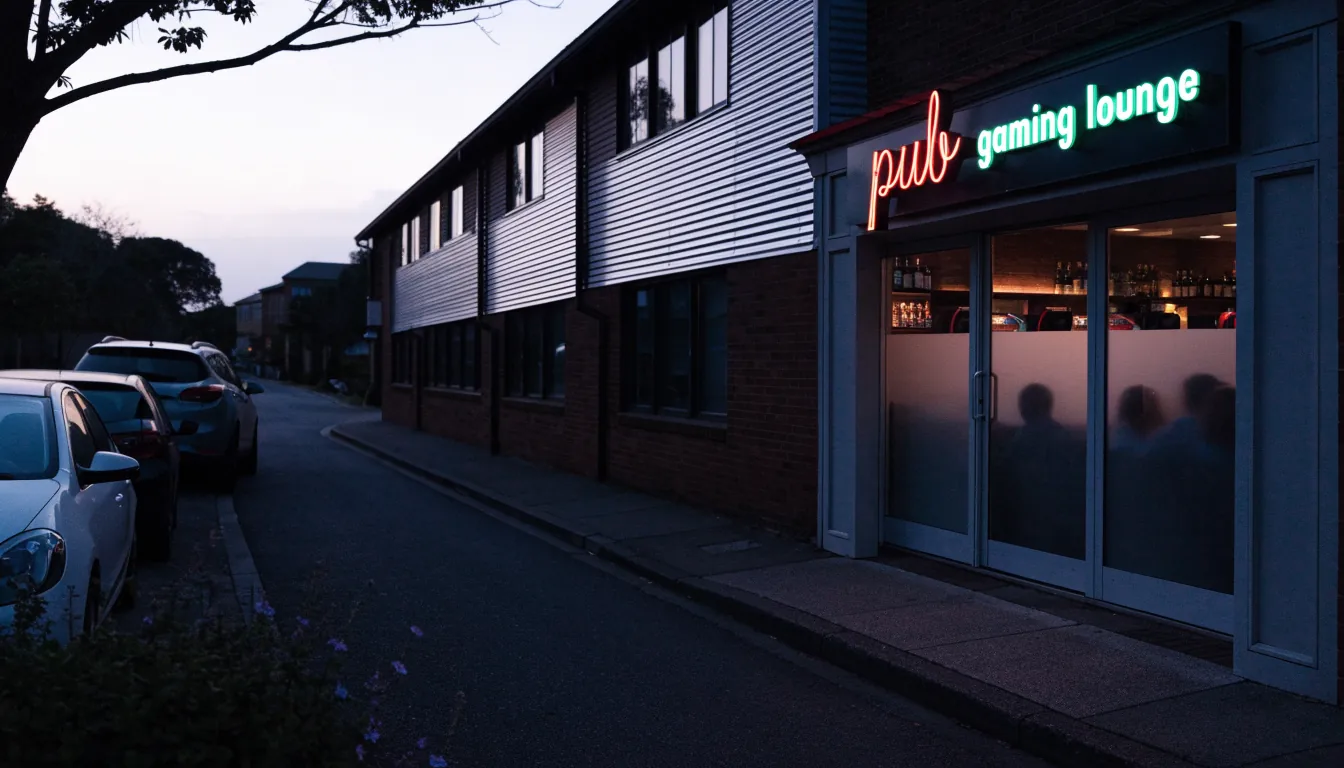
Location results can point to possibilities, but distance, opening hours and machine access require venue-level verification.
Finding a Pokies Venue Near Sydney: What Location Searches Can—and Cannot—Tell
A request for pokies near Sydney sounds like a simple matter of distance. In practice, it bundles together several different questions: whether a venue exists, whether it is near the part of Sydney that matters, and whether it is open when someone plans to go. A map pin or a short list of results may look like an answer, but it is only a starting point. A place appearing in a location-based result does not, by itself, establish that its details are current or that it offers what the searcher has in mind.
“Near me” is particularly elastic. Its meaning depends on where the search is made and what counts as near: a short walk, a convenient trip across town, or somewhere within the wider metropolitan area. Those are not interchangeable ideas. Sydney’s size gives the word plenty of room to mislead. A result can be technically nearby in a broad sense and still be inconvenient for a particular journey.

The same problem appears when the request is tied to a landmark or transport point. A person looking around the central business district may have a different practical boundary from someone starting at Central Station or travelling through another part of the city. The phrase “near Sydney” does not settle that boundary. Nor does it tell whether a listed business is a club, a hotel or another kind of venue. Location is not description.
Search wording can also blur separate categories. Looking for an in-person venue is not the same as looking for an online option, even when both are described with the same familiar word. An online result does not indicate a physical room nearby; a venue result does not answer questions about an online service. The distinction matters before any map is opened, because otherwise two different kinds of destination are being treated as one.
Airport-adjacent wording adds another layer of apparent precision. An airport is a recognisable point on a map, but a reference to it does not prove that a particular venue is inside the terminal, close to it, or practical to reach from there. The same applies to searches around a station or the central business district. A landmark can help define an area; it cannot authenticate every result associated with that area. Place names are good at attracting attention. They are less good at supplying evidence.
There is a small social history in this habit of searching. A city is experienced not as a neat administrative outline but as a sequence of errands, transfers, familiar streets and places where time is being spent. “Near” is a request shaped by that lived geography. Digital maps, by contrast, flatten the city into pins and labels. The convenience is real, but so is the compression: a result can appear settled before the underlying details have been checked.
That is why a search for a Sydney venue should be treated as a lead, not a confirmation of an address, current operation or opening status. Those details belong to the venue itself and need to be established at venue level. A phrase such as “open now” expresses a desired moment, not proof of a schedule. Likewise, a result tied to a neighbourhood does not establish that it is the closest or most suitable option. Search tools organise information; they do not turn proximity into certainty.
Age is a different question, and here the rule is clear. In Australia, the minimum age for all forms of gambling, including online pokies, is 18. The boundary applies regardless of whether the setting is a physical venue or a screen. It is a legal threshold, not a feature of a particular suburb or a condition that changes with the journey.
The practical meaning of “near Sydney” therefore remains modest: it points towards a place to investigate. It cannot, on its own, establish where that place is, what it offers, or whether its details still hold. A pin is a prompt, not a promise.
Online Pokies and the Australian Legal Divide
A Sydney casino’s physical gaming floor and an online pokie bearing familiar imagery may look like parts of one industry. Under Australian law, they are not the same legal proposition. The Interactive Gambling Act 2001 prohibits companies from providing real-money online casino games, including pokies, to people in Australia unless they hold a domestic licence. No Australian online casino licences have been issued. The absence is decisive: there is no locally licensed online casino.
Legal Status
No Australian online casino licences have been issued, meaning there is no locally licensed online casino providing real-money pokies.
That distinction matters when a search for online pokies near Sydney returns a mixture of casino names, offshore websites and promises of play from home. A result appearing on a screen does not establish that its service is authorised in Australia. Nor does a physical casino’s existence make an online version lawful. The rules for gambling at a venue and the rules for a company supplying casino-style games over the internet are separate; one cannot be used as a passport for the other.
The law is directed at the operators providing prohibited services, not at individual players. Australians are not made criminally liable simply for playing on an offshore site that accepts them, and they can legally play on such sites. But that does not turn the operator’s service into an Australian-licensed one, or give the player the protections that a domestic licence might suggest. The legal divide is an awkward one: the player is not the target of the prohibition, while the service remains outside Australia’s lawful online casino framework.
A Star Casino Sydney search, or a search for real-money play associated with Sydney, therefore needs a careful distinction. A name connected with a physical venue does not establish that an online casino carrying that name is authorised to take Australian customers. The same applies to claims about cashless play, high stakes, maximum bets or a “no deposit” offer. Those words describe features or inducements; they do not change the legal status of an online casino service. An offer is not a licence.

There is a further practical limit. The Australian Communications and Media Authority blocks access to illegal offshore gambling sites, and internet service providers must comply with its blocklist. Blocking is an enforcement measure, not a guarantee that every offshore site will disappear from view or that a site still reachable is lawful. A website’s accessibility is a poor substitute for legal status.
The sharper risk arrives when money is owed. If an offshore casino refuses to pay winnings, Australian players have no legal recourse in Australia. That is not a minor inconvenience in the fine print; it is the difference between dealing with a locally accountable service and relying on an operator beyond the domestic system. A page promising the best-paying pokies in Sydney cannot establish either a reliable payout or an Australian route to challenge a refusal. “Best paying” is a claim, not a remedy.
This is also why online bonuses and venue searches should not be folded together. A Sydney no-deposit offer, or a claim about online pokies for real money, does not become a local venue offer merely because the wording includes Sydney. Nor does a result mentioning Newcastle or a named casino prove that machines or an online service are available there. Place names can lend a page an air of local authority without changing who provides the gambling service or which law applies.
Australia’s arrangement leaves a conspicuous gap between personal liability and consumer protection. The law does not prosecute the player simply for using an offshore site, yet it does not supply an Australian-licensed online casino or a domestic remedy when that operator withholds a payout. The distinction is legal, not reassuring. A familiar brand, a reachable page and a confident claim about winnings cannot close it.
Financial Risk
If an offshore casino refuses to pay winnings, Australian players have no legal recourse in Australia.
When Sydney Pokies Are Open, the Machines Have Their Own Rules
An early start can look simple on a timetable: doors open, the room is accessible, the machines are running. In practice, those are separate things. A venue’s general opening time does not, by itself, establish when its pokies operate. Nor does a broad claim about Sydney tell much about a particular hotel or club. The distinction matters to anyone trying to work out whether machines are available early, late, or at all at a given time.
The same applies to searches for a six o’clock or seven o’clock start. Those hours are requests for a specific operating schedule, not evidence that a Sydney venue provides one. A listing may describe a venue’s trading hours without clarifying the hours of its gaming area. Even a sign that a venue is open cannot settle the question of whether its pokies are operating. Timetables belong to individual venues; general labels are a poor substitute.
There is also a staffing obligation tied to machine operation. In a report on changes to venue rules, regionriverina.com.au says that, from 1 July, a venue with more than 20 gaming machines is required to have a dedicated responsible gambling officer (RGO) on duty whenever those machines are operating. The detail is easy to miss because it is not a promise about opening times. It is a condition attached to the period in which the machines are running.
That shifts the emphasis from the hour on a venue’s front door to the arrangements behind its gaming floor. For larger machine rooms, operation carries a staffing responsibility: the RGO is meant to be present while the machines are in use. It does not follow that every venue must open at a particular hour, that every hotel has the same schedule, or that a machine room runs for as long as the building does. The rule describes an obligation during operation, not a citywide timetable.
This is why “open early” and “open late” are slippery descriptions. They can refer to a building, a bar, a restaurant or a gaming area, and those meanings are not interchangeable. A hotel may welcome patrons while its pokies are unavailable; a late trading claim may say nothing about machine access. The wording on a venue listing needs to be read for what it actually covers, rather than what a hurried glance might suggest.
Staffing Rule
From 1 July, any venue with more than 20 gaming machines must have a dedicated responsible gambling officer (RGO) on duty whenever machines are operating.
The same caution applies to claims about a payout percentage. A venue’s hours, its staffing arrangements and a machine’s return setting are different matters. An opening schedule does not reveal a pokie’s return, and a general statement about a game cannot establish the setting used at a particular venue. The clock is not a performance measure.
For a specific Sydney venue, the useful question is therefore narrow: what hours apply to its gaming machines, rather than to the premises as a whole? An answer needs to come from venue-level information. No broad description of Sydney, and no assumed pattern for hotel pokies, can fill in that schedule.
The rule for larger venues gives the operating period a human condition: when the machines are running, a responsible gambling officer must be on duty. It does not turn an early-opening search into a confirmed time, and it does not say when a particular Sydney gaming floor begins or ends its day.
A timetable is not a guarantee.
What “Best” Can Mean When Comparing Pokies
Choosing pokies in Sydney for 2026 is easier when you can check the practical details that are available, such as licensing, payment times and minimum deposits. Use these notes as a starting point and review each casino’s current terms before playing.
-
WinSpirit Casino
- License
- Curacao eGaming OGL/2024/923/0383 (Antillephone N.V.)
- Min. deposit
- A$30
WinSpirit Casino lists a Curacao eGaming licence, OGL/2024/923/0383, issued through Antillephone N.V. Its stated minimum deposit is A$30.
-
SkyCrown
- License
- Tobique Gaming Commission
- Payout speed
- crypto ~10-15 minutes, fiat 1-5 days
- Min. deposit
- A$30
SkyCrown lists a Tobique Gaming Commission licence and a minimum deposit of A$30. Its stated payout times are around 10–15 minutes for crypto and 1–5 days for fiat.
-
Vegaz Casino
- License
- Curacao OGL/2024/1335/0780
- Min. deposit
- EUR 20
Vegaz Casino lists a Curacao licence, OGL/2024/1335/0780. Its stated minimum deposit is EUR 20.
-
Ricky Casino
- Payout speed
- crypto under 1 hour, PayID 1-3 business days
- Min. deposit
- A$20 (A$30 to qualify for the bonus)
Ricky Casino lists crypto payouts in under an hour and PayID payouts in 1–3 business days. The minimum deposit is A$20, or A$30 to qualify for the bonus.
-
DragonSlots Casino
- License
- Curacao Gaming Authority (Jumpman Gaming Ltd)
DragonSlots Casino lists a Curacao Gaming Authority licence, with Jumpman Gaming Ltd named in connection with it.
-
Thor Casino
- License
- Curacao – Antillephone N.V. (Versus Odds B.V.)
- Min. deposit
- EUR 20
Thor Casino lists a Curacao licence through Antillephone N.V., with Versus Odds B.V. named in connection with it. Its stated minimum deposit is EUR 20.
-
JustCasino
- License
- Curacao Gaming Control Board
JustCasino lists a Curacao Gaming Control Board licence.
-
Rollero Casino
- License
- Curacao Gaming Control Board OGL/2023/176/0095 (Hollycorn N.V.)
Rollero Casino lists a Curacao Gaming Control Board licence, OGL/2023/176/0095, with Hollycorn N.V. named in connection with it.
-
GoldenCrown
- License
- Curacao Gaming Control Board OGL/2023/176/0095 (Hollycorn N.V.)
GoldenCrown lists a Curacao Gaming Control Board licence, OGL/2023/176/0095, with Hollycorn N.V. named in connection with it.
-
Uptown Pokies
- License
- Curacao (operating since 2017)
- Min. deposit
- A$20
Uptown Pokies lists a Curacao licence and states that it has operated since 2017. Its stated minimum deposit is A$20.
“Best” sounds like a verdict, but paying potential is not a single quality that can be read from a game’s name. A return figure describes a setting, not a promise about what happens on a particular machine or during a particular visit. That distinction matters in Sydney as much as anywhere else: a claim about a pokie cannot, by itself, establish what a specific venue offers or what a player will receive.
A specialist review reports that some game providers allow casinos to choose between multiple return-to-player settings for the same pokie. The title may therefore be identical while its configured return differs from one casino to another. A figure attached to a game in general is not proof of the setting at a particular venue. Nor does the word “best” settle the question: without venue-specific information, a comparison of names alone cannot establish which option has the higher setting.
Even a confirmed return figure is not a forecast for an individual. It describes a mathematical property of the game setting, not a schedule of payments. It cannot say that a particular spin will pay, that a run of losses is due to end, or that a short session will reflect the advertised figure. Those are tempting interpretations because a percentage looks precise. Precision, however, is not prophecy.

The mechanism behind each spin is a Random Number Generator. Each result is produced independently, rather than being a response to what happened on the previous spin. A machine does not remember a losing sequence and compensate for it; a recent win does not make another win more likely. The previous result is history, not a hint. That is the essential limit on any claim about “paying” pokies: a return setting cannot turn chance into a timetable.
This also changes how “best paying pokies in Sydney” can sensibly be understood. It is a request for evidence about a particular game and its configured setting, not a dependable shortlist of machines that will produce winnings. A responsible comparison would separate the game’s stated return from any claim about a venue’s setting, and both from the outcome of an individual play. Where those distinctions are collapsed, marketing language begins to sound more certain than the underlying mechanics allow.
The same caution applies to a game encountered under the same title at different casinos. Familiarity with one version does not establish that another venue has selected the same return setting. A general description may tell something about the game, but it cannot prove a local configuration. That is why a ranking of unnamed Sydney machines would be little more than theatre: the label “best” would imply a comparison that the available information cannot support.

There is a social habit behind the search for the best-paying machine: the hope that enough information can make uncertainty yield. In practice, return figures can clarify one feature of a game, while the random character of every spin remains untouched. A number can describe the rules. It cannot disclose the next result. Dry arithmetic, then. No forecast.
Airport and North Sydney Searches Need Venue-Level Verification
An airport name can describe a broad area, not a particular gaming floor. The same is true of North Sydney: a location label may cover many kinds of premises, while the relevant question is whether a specific venue has pokies available. A map pin, directory entry or passing reference to the area does not settle that question.
For Sydney Airport, the distinction matters because “at the airport” can mean inside a terminal, somewhere on airport grounds or in the surrounding district. Those are not interchangeable descriptions. A result that places a business near the airport does not establish that pokies are inside the terminal, or even at that business. The venue itself has to be identified before its facilities can be understood.
North Sydney presents a similar problem in a different urban setting. The suburb name may appear beside restaurants, clubs, hotels and other premises, but the label alone says nothing about which of them, if any, has a gaming floor. “North Sydney pokies” is therefore not a description of one place. It is an area attached to a facility claim, and the second part needs its own evidence.
A useful check begins with the exact venue name and street address, then asks whether the venue itself describes gaming facilities. If an entry names only a district, offers no clear venue identity or points to a third-party listing, it cannot bear much weight. Details should agree across the venue’s own information and any current, authoritative record relevant to licensed premises. If the wording is vague, the location claim remains vague too.
The same discipline applies to Sydney city searches. “In the city” may refer to the central business district or to a wider part of inner Sydney; it is not a precise address. Combining the city label with an airport or North Sydney result can make separate places look like one convenient cluster. They are not.

A request for the maximum cash payout in Sydney cannot be answered by the suburb or airport label either. A payout figure would need to belong to a specific machine and setting at a specific venue. A broad area name cannot establish either one, and a figure detached from those details risks sounding more definite than it is.
The practical distinction is small but consequential: place first, facility second, machine details last. Without that sequence, the apparent certainty of a map or search result does more work than it should.
The age rule is not local to either district. Gambling in Australia, including online pokies, is restricted to people aged eighteen or over. Location does not alter that threshold. A boundary on a map, after all, is not a change in the law.
What Can Be Said About Crown Sydney—and What Cannot
A name such as Crown Sydney can make a question about pokies sound more settled than it is. The venue name identifies the subject of the inquiry; it does not, by itself, establish which games are on a floor, what settings they use, or whether a particular machine is available. Those are separate claims, and each needs information tied to the venue rather than a general description of a game.
The distinction matters most when a pokie is discussed in terms of its return to player, or RTP. An RTP figure describes a theoretical return across extensive play, not a promise about the result of an individual session. Even a figure attached to a game cannot automatically be carried from one casino to another. A specialist review reports that some game providers give casinos a choice of RTP settings for the same pokie. The game’s title may stay the same while its selected return setting differs.
That possibility narrows what general information can establish. A published figure for a game, where one is available, does not confirm the setting at Crown Sydney. Nor does a game’s presence in a catalogue prove that it is installed at a particular venue. A claim about a specific Crown machine would need to identify the game and connect its stated setting to Crown itself. Without that venue-level link, the figure belongs to the general game discussion, not to a confirmed Crown offering.

This is why “best” becomes slippery when attached to a named gaming floor. It could mean a player’s preferred theme, a particular style of play, or a stated RTP. Those are not interchangeable measures. A preference is personal; an RTP is a theoretical measure; and neither establishes that a game is available at a named venue. A confident ranking can conceal those differences rather than resolve them.
The same care applies to descriptions of a “pokies room” at Crown. A phrase can suggest a specific space and a definite range of machines, but the words alone do not verify either. Venue descriptions, maps and promotional summaries may answer different questions; none should be treated as evidence for a machine setting unless that detail is explicitly attached to the venue and the game.
Crown-related claims are therefore best read at the level they actually support. General information about how RTP settings can vary explains why the same pokie may not have one universal return figure. It does not disclose Crown Sydney’s settings or confirm its current machine selection. The distinction is small in wording, but substantial in meaning. A name is not a setting.

Sydney Pokies Venues and the Duties Behind the Gaming Floor
A venue’s character is not captured by its machines alone. The less visible measure is how it handles the people around them: what staff are expected to notice, what must be recorded, and which messages are allowed to remain in view. Those duties belong to the venue, not to a claim that one gaming floor is the best in Sydney.
For venues operating more than twenty gaming machines, the rules require a dedicated responsible gambling officer (RGO) to be present whenever those machines are running, from 1 July. That makes the role part of the operating arrangement, rather than a title that can sit on a staff list while the gaming floor is open. A responsible gambling officer is meant to be available in the setting where signs of harm may become apparent.
The transition has been reported as including a one-month grace period for venues to take down signage and put the officer arrangements in place. Region Riverina’s report also describes a requirement for venues to maintain a gambling incident register. It is intended to capture events in which a patron’s conduct suggests that gambling may be causing harm or putting them at risk. The register turns an observation into something the venue is expected to document, rather than leave as an informal impression.
Do
- Ensure an RGO is present during machine operation
- Maintain a gambling incident register
- Remove gaming lounge signs near ATMs
Don't
- Rely on a policy without a physical record
- Place ATM directions visible from machines
- Assume signage equals responsibility
Record-keeping is not a cure. It does, however, create an account of how a venue responds when concern becomes visible. The distinction matters: responsibility is not fulfilled simply because a notice is on a wall, or because a policy exists somewhere behind the counter. A record and an officer make the duty more concrete.
Signage has its own boundaries. Directions to gaming lounges must be removed when they are within sight of ATMs or EFTPOS terminals; directions to ATMs must come down when visible from gaming machines. The point is not decorative consistency. It is to avoid placing prompts to continue gambling or obtain cash where they can shape decisions on the gaming floor. A sign can be small and still do its work.
These obligations offer a more grounded way to think about Sydney’s pokies venues than an unsupported ranking. A venue’s stated standards are one thing; the visible presence of an RGO, the handling of incidents and the placement of signs are matters of practice. The regulatory language may sound administrative. Its subject is not. It concerns the moment when entertainment stops looking harmless, and whether the institution notices.
A “24-Hour” Search Is Not Proof of 24-Hour Machine Access
“Open now” sounds like a simple status: doors open, lights on, service available. For pokies, though, those are separate questions. A venue may trade while its gaming floor is closed, or its public opening information may say nothing about when machines can be used. A round-the-clock label, without a venue-specific schedule for the gaming floor, proves only that the label has been applied.

That distinction matters in Sydney, where a broad claim about 24-hour pokies access can travel further than the details needed to support it. Venue hours and machine operating hours are not interchangeable. Nor does a current indication that a venue is open establish that pokies are operating at that moment. The relevant detail is the operating schedule for the machines themselves, tied to a specific venue and kept current.
The wording of an opening-hours listing can obscure this. “Open” may refer to a bar, accommodation, reception or another part of a business; it need not describe the gaming floor. A listing may also be old or incomplete. Those gaps do not prove that machines are shut, any more than a venue’s open status proves they are available. The claim has to match the thing being claimed.
There is a public-facing responsibility attached to machine operations, too. A report by regionriverina.com.au says that, from 1 July, venues operating more than 20 gaming machines are required to have a dedicated Responsible gambling officer (RGO) on duty while those machines are running. That requirement makes the distinction between venue activity and machine activity more than a matter of wording: the relevant duty follows the machines’ operating period.
Still, the rule does not supply a timetable for any particular Sydney venue. It identifies an obligation when machines are operating, not a promise that they operate throughout the day or night. A venue’s own current information is the place to look for its stated hours; confirmation that those hours apply to pokies, rather than to the venue generally, is a separate matter.
A search result can point towards a possibility. It cannot, by itself, establish continuous machine access, current operating status or the hours of a specific gaming floor. “Open now” is a narrow claim about a door. The machines are another question.
CBD Clubs, Gaming Floors and Practical Limits
A search for Sydney clubs with pokies can make the city centre sound like a catalogue of gaming floors. But a club’s presence, its machines and the way they are managed are separate matters; a name in a listing does not explain what practical safeguards are available inside.
Responsible-gambling tools are less glamorous than a winning screen, which is precisely their purpose. Deposit limits set a boundary on funds put into play. Loss limits can constrain losses, while session time limits place a boundary on how long a gambling session continues. Self-exclusion offers a different kind of limit: a person can seek to prevent their own access to gambling at participating venues. These measures do not predict a result or change the randomness of a game. They are controls around participation.
For someone considering a club gaming floor in the CBD, the useful question is therefore not which venue can be called “best”, but what limits can be set and how exclusion works in that particular setting. The existence of a general safeguard does not establish that every club uses every tool in the same way. Venue-level details matter, and should be confirmed with the venue rather than inferred from a broad description of Sydney clubs.
Self-exclusion also has boundaries. BetStop is a national self-exclusion register for Australian-licensed wagering operators; it does not bind offshore sites. It should not be mistaken for a universal switch that blocks every form of gambling or every venue. For physical venues, the relevant process is the one that applies to the venue itself.
There is a quiet difference between a limit and a promise. A limit can interrupt a pattern, but it cannot guarantee that gambling will remain harmless or that a person will keep to a plan once play begins. Deposit, loss and time controls are most useful when their terms are understood before entering a gaming area, not when a session has already acquired its own momentum.
The city’s club culture often joins dining, social life and gaming under one roof. That arrangement can make the boundary between an evening out and a gambling session feel less distinct. Practical safeguards restore some definition. They do not make the floor harmless.
Parkes in a Sydney Search: A Location Term, Not a Verified Venue
The words “Parkes” and “Sydney” can sit together in a phrase without identifying a particular place. They might be intended to narrow a location, refer to a venue name, or reflect an imprecise description. None of those possibilities, on its own, establishes that a Sydney venue called Parkes exists or has pokies available.
That distinction matters when looking for pokies in Parkes, Sydney. A place-name in a description is not a venue address, and a venue name is not evidence of what is on its gaming floor. The same care applies to claims about the best pokies in Sydney: a location attached to a game does not make it better, nor does it establish that the game is available there.
This is a small problem of language with practical consequences. Names travel easily between maps, listings and conversation; the details needed to identify a specific venue do not. When Parkes appears beside Sydney, the wording should be treated as ambiguous until the place itself is clearly identified. Guessing at the intended location can turn a loose label into a misleading claim.
Even a confirmed location would not make a particular outcome more dependable. Every pokie spin is an independent event generated by a Random Number Generator. The result of one spin does not set up the next, and a previous win or loss does not create a reliable pattern. A machine’s location cannot change that basic fact.
So “Parkes” may help describe what someone is trying to find, but the phrase alone cannot verify a Sydney venue or its machines. Place names can point in several directions. The next spin points nowhere.
Are online pokies legal for Australian players?
Australians can legally play on offshore sites that accept them, but no Australian-licensed online casino exists. The law prohibits companies from providing real-money online pokies without a domestic licence, and players have no legal recourse in Australia if an offshore casino refuses to pay.
Are online pokies rigged?
Each spin is an independent random event determined by a Random Number Generator. Some providers also let casinos choose between different RTP settings for a game, so the same pokie may have different return percentages at different casinos.
What is the best payment method for fast withdrawals in Australia?
E-wallets such as Skrill and Neteller are popular for their speed. Check the casino’s withdrawal terms as well: some impose weekly or monthly payout limits, and most require identity verification before the first withdrawal.
What is the cost-benefit calculation of casino promotions?
Compare the wagering requirement with the bonus amount and any cash-out cap on winnings. For example, a $500 bonus with a 40x requirement means $20,000 in bets before withdrawing winnings; if the requirement applies to a $500 deposit plus a $500 bonus at 35x, it means $35,000 in bets.
Can casinos change the RTP of their games?
Some game providers allow casinos to choose from multiple RTP settings for a pokie. As a result, the same game can have different return percentages at different casinos.
Created by the Casino WinSpirit editorial team.