

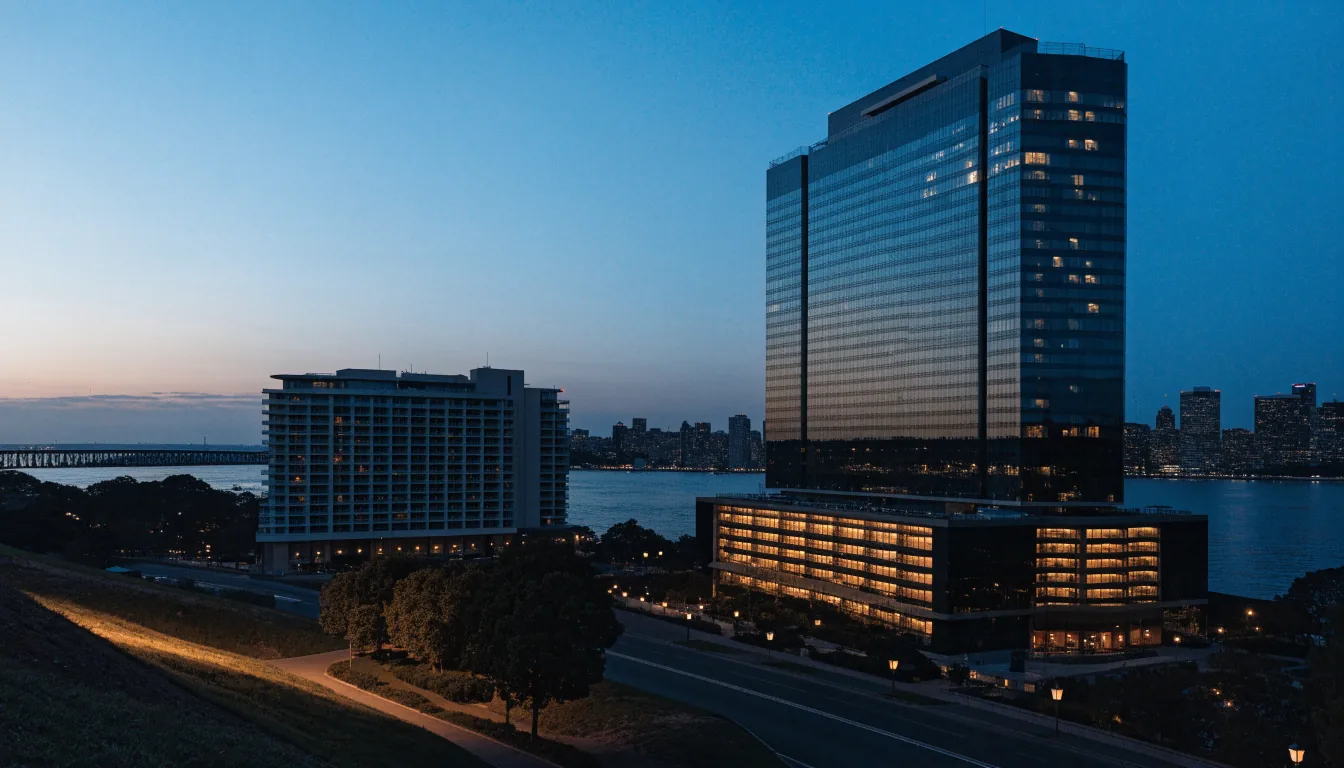
A practical guide to Sydney casino accommodation, gaming, dining and access, with clear limits on what listings can confirm.
Sydney Casino Stays, Without the Guesswork
A casino hotel can mean two quite different things. In the narrow sense, it is accommodation within the casino property or directly integrated with it. In the looser sense used in travel listings, it may mean a hotel elsewhere in the city that is convenient for a casino visit. The distinction matters: proximity is not the same as being on site, and a hotel’s appearance beside a casino in a booking result does not establish a shared property.
That is the first useful distinction behind a Sydney casino stay. An on-site room, if offered, belongs to the venue’s own accommodation operation. A separate city hotel remains a separate booking, even if its location makes a visit practical. The words “near the casino” describe a relationship of location, not a partnership, a shuttle service or a combined package.
The phrase “casino hotel” can also suggest more than it promises. It does not, by itself, confirm that rooms are available for particular dates, that a reservation includes access to anything beyond the room, or that a special rate exists. A deal may refer to a room price, a bundle, or simply promotional wording; the details determine which. Labels are not terms and conditions.
Choosing a casino in Sydney means checking which details are actually available before deciding where to play. This list offers a concise reference to the listed operators and their stated licensing, deposit, or payout information.
-
WinSpirit Casino
- License
- Curacao eGaming OGL/2024/923/0383 (Antillephone N.V.)
- Min. deposit
- A$30
WinSpirit Casino lists a Curacao eGaming licence, OGL/2024/923/0383, issued through Antillephone N.V. Its minimum deposit is A$30.
-
SkyCrown
- License
- Tobique Gaming Commission
- Payout speed
- crypto ~10-15 minutes, fiat 1-5 days
- Min. deposit
- A$30
SkyCrown lists a Tobique Gaming Commission licence and a A$30 minimum deposit. Its stated payout times are around 10–15 minutes for crypto and 1–5 days for fiat.
-
Vegaz Casino
- License
- Curacao OGL/2024/1335/0780
- Min. deposit
- EUR 20
Vegaz Casino lists a Curacao licence, OGL/2024/1335/0780. Its minimum deposit is EUR 20.
-
Ricky Casino
- Payout speed
- crypto under 1 hour, PayID 1-3 business days
- Min. deposit
- A$20 (A$30 to qualify for the bonus)
Ricky Casino lists a A$20 minimum deposit, with A$30 required to qualify for the bonus. Stated payout times are under an hour for crypto and 1–3 business days for PayID.
-
DragonSlots Casino
- License
- Curacao Gaming Authority (Jumpman Gaming Ltd)
DragonSlots Casino lists a Curacao Gaming Authority licence, with Jumpman Gaming Ltd named in connection with it.
-
Thor Casino
- License
- Curacao – Antillephone N.V. (Versus Odds B.V.)
- Min. deposit
- EUR 20
Thor Casino lists a Curacao licence through Antillephone N.V., with Versus Odds B.V. also named. Its minimum deposit is EUR 20.
-
JustCasino
- License
- Curacao Gaming Control Board
JustCasino lists a Curacao Gaming Control Board licence.
-
Rollero Casino
- License
- Curacao Gaming Control Board OGL/2023/176/0095 (Hollycorn N.V.)
Rollero Casino lists a Curacao Gaming Control Board licence, OGL/2023/176/0095, with Hollycorn N.V. named.
-
GoldenCrown
- License
- Curacao Gaming Control Board OGL/2023/176/0095 (Hollycorn N.V.)
GoldenCrown lists a Curacao Gaming Control Board licence, OGL/2023/176/0095, with Hollycorn N.V. named.
-
Uptown Pokies
- License
- Curacao (operating since 2017)
- Min. deposit
- A$20
Uptown Pokies lists a Curacao licence and states that it has been operating since 2017. Its minimum deposit is A$20.
What a room search can—and cannot—settle
A search for casino hotel rooms in Sydney points to accommodation, but it cannot settle the practical questions that make a stay workable. Those include whether the property is actually on site, what the quoted room rate covers, and whether the offer applies to the intended dates. These are booking details, not qualities that can be inferred from the words “casino hotel.”
The same care applies to photographs and map pins. A polished image can show a room without establishing what category it belongs to or whether it is available. A pin can make two places look close without explaining whether they share an entrance, a booking system or any other arrangement. The useful description is the one attached to the specific room and rate, not the broad label above it.
A “deal” is especially elastic. It might be a reduced room rate, a package with stated inclusions, or a headline whose value depends on conditions elsewhere in the offer. Until those conditions are clear, the word is a marketing category, not a saving that can be measured. A room price should be understood on its own terms, rather than treated as proof that a casino visit has been folded into the stay.
There is no need to make this more mysterious than it is. The essential questions are ordinary: Is the accommodation part of the casino property or a separate hotel? What does the quoted rate include? Which dates and room type does it cover? If the booking description does not answer these, the missing detail should not be supplied by assumption.

A Sydney stay, not a promised package
For visitors comparing hotels in Sydney near a casino, the city-wide lodging choice and the casino visit are separate decisions unless a booking explicitly joins them. A nearby hotel may suit an itinerary; an on-site hotel, where available, would be a different proposition. Neither description alone establishes quality, price or convenience. Those depend on particulars, and particulars belong to the actual listing.
This restraint can feel unsatisfying in a category built around attractive shorthand. “Casino hotel Sydney” sounds like one settled product. In practice, it may describe a property, a location or a search label. Treating those meanings as interchangeable turns a vague phrase into an expectation the booking may not meet.
The same goes for Sydney casino hotel deals. No room offer, rate or package should be presumed from the category itself. A stay is confirmed by its booking terms, not by the casino in the headline. A small distinction, with a large invoice attached.
Poker Rooms, Poker Machines and the NSW Rules
Poker can describe two very different activities in a Sydney casino. In a poker room, players compete at a table, and a tournament is an organised form of that table game. Electronic Gaming Machines (EGMs), by contrast, are the machines commonly called pokies in Australia. The shared word does not make the games or their rules interchangeable.
NSW Gaming Laws
In New South Wales, a person must be at least 18 to gamble on poker machines. Underage machine gambling is not permitted and can carry legal consequences.
That distinction matters when a venue is described simply as offering “poker”. The word alone says little about whether the subject is table play, a tournament or machine gambling. Nor does a search for a poker room establish that a particular room, game or tournament is operating. Those are separate questions from the rules governing pokies.
The rule for machine play
In New South Wales, a person must be at least 18 to gamble on poker machines. Venues must check identification to confirm eligibility; underage machine gambling is not permitted, and failing to comply with the age rule can carry legal consequences. The rule is not a formality attached to the name of a venue. It applies to the act of playing the machines.
NSW also requires a pre-commitment system for machine play. Before playing, a person sets a loss limit. The system makes that boundary part of the process rather than leaving it to memory after play has begun. It does not turn gambling into a predictable activity, or change the chance built into each game. It sets a limit in advance.
There is a social idea embedded in that arrangement: decisions made before the pressure of play are treated differently from decisions made during it. Regulation cannot remove the impulse to continue, but pre-commitment gives a player a stated boundary against which to measure it. A modest piece of machinery, carrying a distinctly human burden.
Table poker is another question
A poker tournament belongs to the table-game side of the distinction, not to the rules for poker-machine gambling. Someone looking for poker at a Sydney casino may therefore mean a room with table games, a scheduled tournament, or simply a place where poker is played. The phrase does not settle which one.
The same care applies to “casino rooms”: it may refer to accommodation, or be used loosely for gaming spaces. Hotel rooms are a different matter from poker rooms, and neither phrase confirms that a particular facility is available. A sports bar is another separate category again. These labels can sit close together in ordinary conversation while pointing to unrelated parts of a venue.
Questions about whether a casino is open today also do not answer whether a poker tournament is scheduled or whether a table is running. Opening status, event schedules and game availability are distinct matters. The useful distinction here is narrower: the NSW age and pre-commitment rules described above concern poker-machine gambling, not a tournament merely because it contains the word “poker”.
The vocabulary is untidy; the age rule is not.
Breakfast, Buffets and the Limits of What Is Known
Breakfast sounds like the simplest part of a casino visit: a meal before the day begins, perhaps a buffet that turns decision-making into a plate. Yet a search for breakfast at a Sydney casino does not establish that breakfast is served, that a buffet operates, or what either might contain. Those are separate details, and a polished venue label cannot fill them in.
The word “resort” can make a casino seem like a complete holiday proposition, with dining folded naturally into the picture. But it describes an impression as much as a practical plan. It does not, by itself, confirm a breakfast room, buffet service, menu, price or serving times. The same caution applies to phrases such as “casino buffet”: they name the kind of meal being sought, not a guarantee that a particular venue offers one.
A buffet is also more than a menu without ordering. Its usefulness depends on details that matter on the day: whether service is running, what food is available, how the meal is priced and whether access is tied to a booking or another condition. None can be inferred from the word “buffet” alone. Without current venue information, a firm description would turn expectation into fact.
Breakfast searches can blur several different arrangements. A hotel dining room, a café, a buffet and a meal included with a stay are not interchangeable. Nor does the presence of a casino settle which, if any, applies. Keeping those categories separate prevents a familiar travel assumption from doing the work of evidence. A casino setting is not itself a breakfast plan.

Rewards programmes create another tempting shortcut. The phrase “casino rewards” may suggest that a meal is included or discounted, but the existence of a search for rewards says nothing about benefits, eligibility or current terms. A benefit cannot safely be attached to breakfast without the programme’s own applicable conditions. Loyalty language is designed to make an arrangement feel personal; the fine print determines whether it is.
Employment searches belong to a different question altogether. Someone looking for work at a Sydney casino is not looking for breakfast service, even if both interests lead to the same organisation. A search for casino jobs does not confirm that positions are open, what roles exist or what qualifications are required. Those particulars need to come from an employer’s current recruitment information, not from the venue’s food reputation or its resort branding.
This distinction matters because hospitality is often imagined as a seamless machine: rooms, meals, rewards and jobs gathered under one roof. In practice, each is a separate promise, and each needs its own confirmation. Food service can change; a job listing can disappear; a rewards offer can carry conditions. A search phrase, however specific, is not a timetable, menu or employment notice.

For anyone comparing breakfast options around a casino visit, the useful evidence is concrete: a current menu, service times, booking information and any stated price or eligibility terms. If those details are not available, the honest description remains limited. No invented menu, no assumed buffet, no implied complimentary meal. A quieter answer, perhaps. A more dependable one.
Parking the Online-Casino Search
Parking and online play belong to different kinds of casino question. One concerns arriving at a physical venue; the other concerns whether casino games can lawfully be offered over the internet to people in Australia. Search results can place them side by side, but the rules do not.
A request about parking in Sydney may mean ordinary parking, valet service or whether parking is free. Those are practical details tied to a particular visit, not facts that can safely be inferred from the word “casino”. Rates, access and availability should be confirmed with the venue before setting out; a guess presented as a current offer would be a poor substitute for information. The same caution applies to dining or bingo: a physical venue search does not, by itself, establish what is available there.
Attention: Under the Interactive Gambling Act 2001, operators based in Australia cannot legally provide real-money online casino services to people located in Australia.
The online question has a clearer legal boundary. Under the Interactive Gambling Act 2001, an operator based in Australia cannot legally provide real-money online casino services to people located in Australia. That restriction covers familiar casino games such as pokies, blackjack and roulette. An Australian-run online casino is therefore not a lawful way to reproduce the gaming floor from home.
Offshore platforms occupy a different, less reassuring position. Australian players are not prohibited from using them in the same way that operators are prohibited from supplying the service, but those platforms are not regulated under Australian law. That distinction matters: being accessible online does not make a service locally supervised, nor does an offshore licence turn it into an Australian-regulated casino.
The law places the burden of prohibition primarily on the provider. It is a rather modern arrangement: the screen can make a business appear near at hand, while its legal accountability remains elsewhere. For someone comparing an in-person casino in Sydney with an online alternative, “available” and “regulated here” are not synonyms.
This also explains why a search for a Sydney casino online can lead to a muddle of unrelated promises. A physical casino has a location and practical questions about getting there. An online casino is a service delivered across borders, and Australian law restricts local operators from supplying it. Offshore sites may present themselves as options, but their presence on a screen does not bring them within Australian regulation.
No amount of convenience language repairs that gap. The legal status of the operator, the location of the player and the distinction between local and offshore services remain central. A parking question is best treated as a venue question; an online-casino question is a question about a prohibited service for Australian operators and an unregulated one when supplied from offshore.
The two searches share a word, not a legal footing. One points towards the journey to a venue; the other towards a service the Australian framework does not permit local operators to provide. That is the distinction worth keeping in view before the terms blur together.
Accommodation Near the Casino: What the Search Cannot Confirm
A stay near a casino and a stay at a casino are different arrangements, though the language used to describe them can blur the line. “Near” is a matter of geography; “at” suggests accommodation connected to the venue itself. Neither phrase, on its own, establishes what rooms are available, how close another property is, or whether a stay includes access to anything beyond a bed.
That distinction matters in Sydney, where a request for casino accommodation may mean an on-site hotel, a separate place to stay nearby, or simply a base from which to visit the venue. These are not interchangeable choices. A hotel attached to a casino would be part of the venue’s own offer; an independent accommodation provider would set its own terms, facilities and relationship, if any, with the casino. A shared place name in a listing would not settle the matter.
The word “deal” adds another layer of assumption. A casino accommodation deal might imply a room bundled with dining, gaming credit or another benefit. Such language is not proof that a package exists, that it is currently available, or that its conditions suit a particular stay. Promotions change; a phrase in a headline can survive longer than the offer it once described. The sensible distinction is between a claim made by a provider and a confirmed arrangement.
There is also a small but consequential ambiguity in “Sydney casino”. It may point to a particular venue in the city, but the words alone do not identify which one. That uncertainty carries through to accommodation: without an identified venue, “near” has no fixed point from which to measure. Even once the casino is clear, proximity does not explain whether a route is direct, whether transport is convenient, or whether the surrounding streets suit a late arrival. Those are separate questions, not hidden features of the word “near”.
A stay planned around a casino can also invite assumptions about the venue’s daily rhythm. Room availability does not establish gaming-machine access, opening times or trading hours; accommodation and gambling operations are different parts of an outing. Nor does an advertised promotion necessarily settle what is included in a booking. Each detail belongs to the provider or venue responsible for it.
The physical setting matters. A room in a casino hotel, if offered, would place the guest within that property’s own arrangements. Lodging elsewhere would leave the journey between accommodation and venue as part of the plan. That difference may shape convenience, but it does not make one option inherently better. A quiet independent stay and an on-site room answer different needs.
So “casino accommodation in Sydney” is best understood as a category, not a promise: it names a kind of trip before it identifies a property, a package or a location. The distinction is plain. The details are not.

Contact, Bars and the Online Games That May Not Appear
A request for a Sydney casino’s contact number is practical in a way that casino advertising rarely is. It may concern a booking, an accessibility question, a bar, or a point on a map. Those are separate enquiries, and a result labelled simply “casino contact” can blur them together. The reliable starting point is the relevant venue operator’s own current information, rather than a number copied into an old directory listing. No particular telephone number or bar listing belongs in a guide unless it can be checked.
The same caution applies to a map or a question about a car park. A map can orient a visitor, but it does not establish where parking is available, whether it is open, or what it costs. Those details are operational and can change. A bar search is similarly specific: the phrase may mean a place to meet before an event, a venue inside a casino complex, or simply confirmation that a particular bar exists. Without current venue information, naming bars or describing their hours would turn a useful distinction into guesswork.

“Baccarat” and “craps” can point somewhere else entirely. They may mean games at a physical casino, or titles expected in an online game lobby. The two settings should not be treated as interchangeable. For online services, a familiar game name does not guarantee that the game will be available to someone connecting from Australia.
An online platform can use an internet connection’s IP address to infer the player’s geographic location. If the location falls within a region excluded by the operator or a game provider, the title may be removed from the lobby. The absence of baccarat, craps or another game is therefore not necessarily a device fault or a sign that the title has vanished everywhere; access can depend on the region identified by the connection.
A specialist review has also reported that a game may fail to load because of regional blocking. That is a reported possibility, not a dependable diagnosis for every blank screen. A loading problem can have other explanations, and the visible result alone does not establish its cause. Geo-blocking may be quiet: no warning, no icon, simply a game that does not appear.
There is a more consequential distinction behind the technology. Under the Interactive Gambling Act 2001, operators based in Australia cannot provide real-money online casino games to people physically in Australia. Offshore platforms are not regulated under Australian law, and online casino-style games remain prohibited services when supplied to customers here. A digital lobby is not the legal equivalent of a room on a casino floor.
So contact, bar and game-lobby questions need different answers. Venue enquiries belong with the operator’s current channels; online game availability is shaped by location and law, not by a promise that every title will load. The interface can be silent. The rules are not.
Opening Hours, Events and the Shape of NSW Gambling
Whether a Sydney casino is open is a practical question with a temporal answer. A venue’s operating hours can change, and an old listing may describe a schedule that no longer applies. The same caution belongs to reopening reports: a headline about development or a planned return does not, by itself, establish what is operating now. Current status and hours need to come from the venue’s own published notices.

The distinction matters because a casino is not only a gaming floor. Searches about entertainment, events and employment point to a larger institution: a place that draws staff, performers and visitors, and whose fortunes are tied to the city around it. Yet a general promise of entertainment says little about what is on a particular night. Event calendars are specific, changeable things; a past programme is not a present one. Dryly, the calendar has no memory.
The same applies to menus. A venue’s food offering may be part of an evening out, but an old menu or an unattributed listing is not a reliable description of what is currently served. Reviews have a similar weakness: they can capture one visit, one event or one moment in a venue’s history, then continue circulating after the circumstances have shifted. A useful review distinguishes its date and subject rather than treating “the casino” as a single, unchanging experience.
There is, however, a stable feature of the NSW gambling framework. Gambling on poker machines is restricted to people aged eighteen or older. NSW also requires pre-commitment systems: players set a loss limit before playing. These rules place a boundary around machine gambling, rather than leaving the decision entirely to the mood of the evening. The limit is part of the state’s approach to making a financial threshold visible before play begins.
NSW Regulations
NSW requires a pre-commitment system for poker machine play, where players set a loss limit before they begin gambling.
That framework sits alongside the commercial life of a venue, but it does not answer whether a particular event is running or whether doors are open at a given hour. Nor does a reopening story settle the distinction between a building’s public activity and its gambling operations. Those are separate questions, and a clear account keeps them separate.
For anyone assessing a Sydney casino review, the most useful details are therefore modest: when it was written, what part of the venue it describes, and whether it concerns an event, entertainment, service or gaming. Broad claims age badly. Opening notices and event schedules can change; the NSW age rule and mandatory pre-commitment requirement describe the regulatory setting in which machine gambling takes place.
Address, Dress and the Geography of Access
An address search belongs to the physical city. It is meant to locate a building, not a game lobby, and the distinction matters when the same casino name appears across maps, booking pages and gambling sites. A venue’s current address and entry conditions should be confirmed through its official channels; neither a dress code nor a list of bars, spa facilities or career openings can safely be inferred from the name alone. Those details change, and a search result can outlive the information it repeats.
The word “casino” also carries a second geography: the one assigned to a device. Online platforms can use an IP address to estimate where a connection originates. If a country is excluded, an operator can block access by refusing connections associated with IP addresses linked to that country. A person may therefore see a different game lobby, or no access at all, depending on the apparent location of the connection. Geography, in this setting, is a technical decision made at the network boundary.

That mechanism does not make an online casino lawful in Australia. The Interactive Gambling Act 2001 prohibits operators from providing real-money online casino games to people physically in the country. A site’s foreign address, overseas branding or visible games elsewhere does not alter that rule. Nor does an apparent opening in a browser establish that the service is authorised for Australians.
A VPN can make a connection appear to come from another country, but using one to reach region-blocked pokies sites is against the relevant terms of service and may result in account suspension. A specialist review has described VPN use as a way to alter a player’s apparent digital location; that is a description of the technology, not a dependable route around restrictions. The digital map can be misleading. The terms still apply.
Queries about a Sydney venue’s dress expectations, bars, spa or employment opportunities concern a particular physical operator, not the broad category of casino games. They need current, venue-specific information. By contrast, an IP-based block is not a dress code for software; it is a boundary enforced before a game may load. The two kinds of access are easily confused only because the same word is asked to do both jobs.
A city has addresses. A platform has borders.
Restaurants and the Wider NSW Gaming Landscape
A restaurant search attached to a casino name can mean two different things: a meal inside the venue, or somewhere to eat in the surrounding part of Sydney. The distinction matters. A venue label does not, by itself, establish which restaurants operate there, what they serve or whether a particular dining option will suit an occasion. Those details need confirmation before a meal is built into the plan.

The same restraint applies to restaurant recommendations. Sydney offers a wide dining scene, but the word “casino” does not make every nearby restaurant part of the casino, nor does proximity establish any connection between a business and the venue.
That leaves a practical division. Dining within a casino is a venue-specific question; dining near one is a question of the wider neighbourhood. The first calls for current information from the venue. The second depends on the location and the kind of meal being sought. Neither can be answered accurately by treating every result as interchangeable. The city is not a single dining room with a gaming floor attached.
There is also a broader NSW context behind the casino label. Gambling facilities are part of a regulated environment, but the scale of machine gaming is not confined to casino properties. Among the state’s clubs, Club Liverpool ranks first for the number of poker machines currently operating. That comparison places machine gambling within a wider network of social venues, rather than presenting it as an activity found only in a casino.
The statistic says something about the distribution of gaming, not about a restaurant, menu or dining experience. A club’s machine count cannot establish what it serves, just as a casino’s profile cannot verify the details of its restaurants. Different questions require different evidence.
For anyone weighing a Sydney casino visit around a meal, the sensible distinction is between what is known about the venue and what remains a separate dining choice. A restaurant attached to a casino may be convenient in principle; its existence, current offer and suitability are matters to confirm directly. Nearby options belong to the city around the casino, not automatically to the casino itself.
A name is not a menu.
Food, Pools and the Difference Between a Venue and a Game Lobby
Food and swimming facilities belong to the physical-world version of a casino visit: the building, its services and the time spent there between other plans. A request for a food court or a pool is therefore not answered by a catalogue of games. Nor does the word “casino” establish that a particular venue has either facility. Those are separate practical details, not properties that can be inferred from the name.
The distinction matters because a casino’s online lobby is not a digital floor plan. It lists games made available through a platform; it says nothing about dining or recreation at a Sydney venue. And its contents may change with the location from which it is opened. A casino or software provider can restrict games in countries where its licensing rules require that restriction. Some software providers have also been reported by a specialist review as blocking Australian players in anticipation of possible future changes to gambling laws. That is a report about particular provider decisions, not a settled rule for every game.
For Australians, the broader boundary is legal as well as technical: operators based in Australia cannot provide real-money online casino games to people in the country. Offshore platforms are not regulated under Australian law, and regional restrictions can prevent games from appearing or loading. A physical venue and an online lobby answer different questions; neither stands in for the other.
The search for a meal or a swim calls for information about the place itself. A game list cannot supply it. And a venue listing cannot explain why an online title is absent. Two maps, really.
What does the legal status of offshore online casinos and NSW gambling law say?
Under the Interactive Gambling Act, Australian-run online casinos cannot offer casino games such as pokies, blackjack or roulette to people in Australia. Australian players are not technically prohibited from using offshore platforms, but those platforms are not regulated under Australian law and may block access based on location; in NSW, you must be 18 to play poker machines, and a loss limit must be set before playing.
What are the different types of pokies?
Progressive jackpot pokies build a growing jackpot from a small portion of each bet. Some pokies also offer a bonus-buy option, which lets players pay a set amount to enter a bonus round directly.
What features are found in modern pokies, including wilds, scatters, free spins, multipliers, and bonus rounds?
Some pokies offer free spins, bonus rounds that can be entered through a paid bonus-buy feature, and progressive jackpots funded by a portion of each bet.
What are the bonuses and wagering requirements?
Free-spin winnings commonly have wagering requirements of 20x to 50x before withdrawal; one stated requirement is 30x. Pokies typically count 100% toward wagering requirements.
Are online casino-style games restricted in Australia?
Yes. The Interactive Gambling Act restricts Australian-based operators from offering online casino games such as pokies, blackjack and roulette to people in Australia. Offshore sites may accept Australian players, but they are not regulated under Australian law and may restrict access to games or services.
Created by the Casino WinSpirit editorial team.