

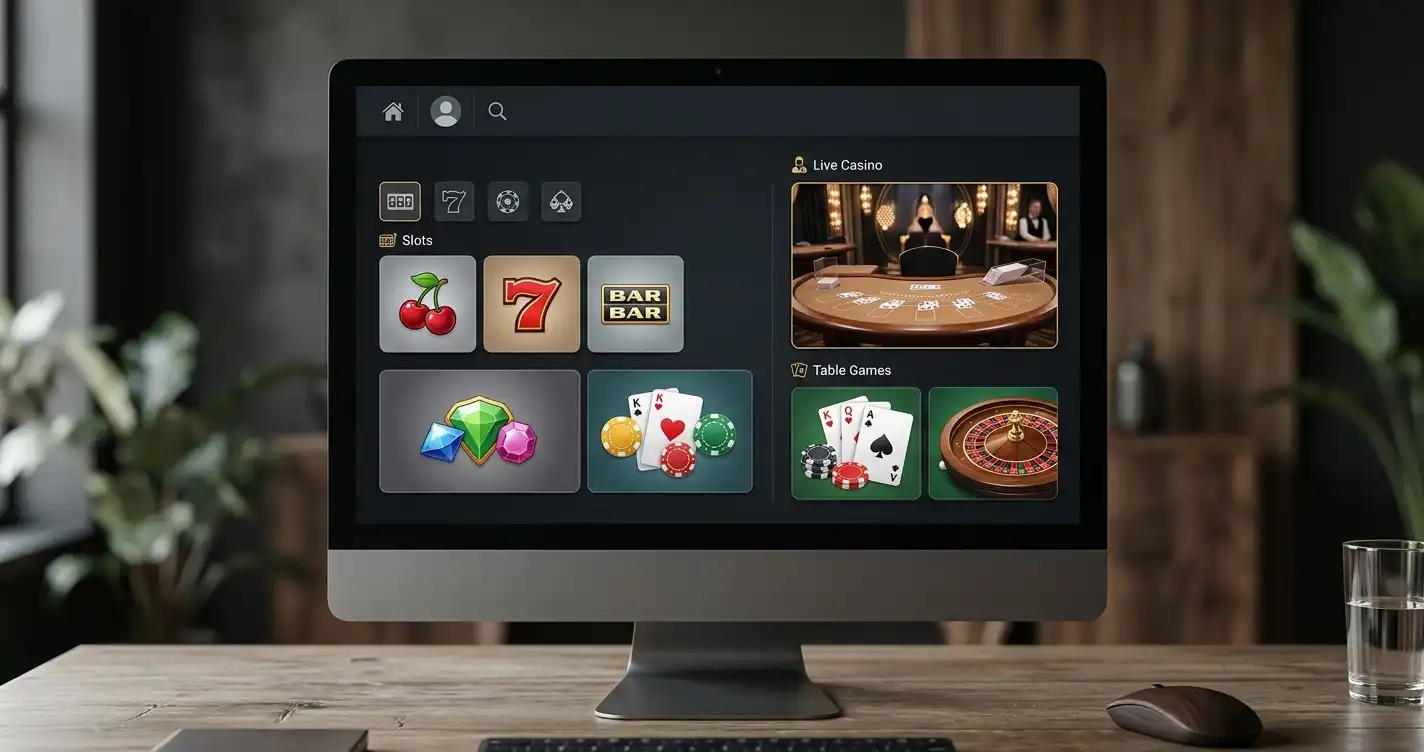
WinSpirit presents a broad casino catalogue spanning slots, live dealer formats, traditional table games, crash titles, jackpots and several adjacent categories. The useful way to read that catalogue is by format and provider instead of by a single headline game count, because the categories and named studios provide a clearer comparison than a single headline total.
The catalogue spans several styles of play
WinSpirit lists slots, roulette, blackjack, baccarat, poker and video poker, bingo and keno, jackpot titles, crash games, table games, live dealer and live-show formats. Sportsbook and eSports also appear in the wider product mix, though the casino catalogue itself is the focus here.
These categories behave differently even before a specific title is chosen. Slots generally use fixed game mathematics with repeated spins. Live dealer games add a streamed table and human dealer. Standard digital table games reproduce familiar card or wheel formats without a live studio. Crash games use a rising multiplier mechanic with a different session rhythm again.
| Category | Examples in the WinSpirit catalogue | What changes for the player |
|---|---|---|
| Slots | Video slots, jackpots and other reel-based titles | RTP, volatility, feature frequency and stake size can differ sharply by game. |
| Live casino | Live dealer tables and live-show formats | Game pace is tied to a streamed session and table rules. |
| Table games | Roulette, blackjack, baccarat, poker and video poker | Rules and house edge depend on the exact variant and pay table. |
| Crash | Multiplier-based crash titles | Round timing and cash-out decisions create a different risk pattern from reels or tables. |
| Bingo and keno | Number-draw formats | Prize structure and draw mechanics replace the spin or table-game cycle. |
That variety makes category filters useful, but category alone is not enough to estimate expected cost or volatility. Two games in the same section can have different RTP, feature structure and pace, so a player still needs to read the information for the specific title. The WinSpirit overview places those game formats alongside the wider product and account structure.
Provider names give the catalogue its shape
The provider roster includes BGaming, Spribe, Games Global, Play’n GO, Pragmatic Play and Pragmatic Live, Evolution, Spinomenal, Relax Gaming, Yggdrasil, NetEnt, Hacksaw, Nolimit City, Playson, Betsoft and Vivo among many others. The list covers studios associated with slots, live dealer games and mixed-format catalogues.
A provider roster is more useful when mapped to game type. Evolution, Pragmatic Live and Vivo are relevant to the live casino section of the catalogue. Studios such as Play’n GO, NetEnt, Relax Gaming, Hacksaw, Nolimit City and Spinomenal are prominent in slot catalogues, while groups such as Games Global aggregate content from multiple studios.
- Live-focused names: Evolution, Pragmatic Live and Vivo.
- Slot-heavy names: Play’n GO, NetEnt, Relax Gaming, Hacksaw, Nolimit City, Spinomenal, Playson and Betsoft.
- Mixed or wider rosters: BGaming, Spribe, Games Global and Pragmatic Play.
Provider totals can change as the catalogue changes. Instead of relying on one fixed count, check the current lobby and use the named roster to understand the range of studios represented.
Live casino is a distinct part of the product
Live play is available within WinSpirit and sits alongside the RNG-driven casino catalogue. Live dealer tables reproduce familiar casino formats through streamed studios, while live-show products add host-led mechanics that can differ from standard roulette, blackjack or baccarat.
The main difference is pace and interaction. A live table advances according to the dealer and table sequence, so the number of rounds per hour is constrained by the studio flow. A digital table or slot can usually progress as fast as the interface allows. That difference changes how quickly stakes accumulate even when the stake per round is the same.
Provider choice also matters in live play because table rules, limits, side bets and presentation differ between studios. Live dealer tables, live shows and the named providers can be compared directly without relying on a fixed table count.
Slot RTP has to be read title by title
WinSpirit publishes RTP examples for individual slots. The listed figures include Fruit Million at 97.10%, Wild Spin at 96.06%, Royal Chip at 95.19% and Odin’s Tree at 96.50%. These are game-specific values, not a platform-wide RTP for WinSpirit.
| Game | Published RTP | Correct interpretation |
|---|---|---|
| Fruit Million | 97.10% | Title-specific long-run theoretical return. |
| Wild Spin | 96.06% | Applies to the named game, not the full slot catalogue. |
| Royal Chip | 95.19% | Should be combined with stake and volatility when thinking about session risk. |
| Odin’s Tree | 96.50% | Another title-level figure instead of a site average. |
RTP is a long-run mathematical measure. It does not predict what a player will receive in a short session, and a higher RTP does not eliminate variance. A slot can still produce long losing stretches or concentrated wins because the distribution of outcomes is separate from the theoretical return percentage.
The named RTP examples are most useful when paired with volatility and session length, because those factors shape the short-run experience even when the theoretical return is similar.
RTP and volatility answer different questions
RTP describes theoretical return over a very large number of plays, while volatility describes how unevenly outcomes can arrive. A title can combine a relatively high RTP with sharp short-term swings, or a lower-volatility pattern with smaller but more frequent outcomes. The two measures so should not be treated as substitutes.
For the four WinSpirit slot examples, the RTP percentages are useful only at the title level. They do not say how often a bonus feature appears, how concentrated the largest prizes are or how a short session will end. Those features depend on the individual game, so two titles with similar RTP figures can still play very differently.
Stake size then turns those game characteristics into money exposure. At the same number of rounds, doubling the stake doubles the amount wagered. Increasing round speed also raises total turnover over time. That relationship is why a session budget and a stake limit are more actionable controls than trying to infer a short-run result from RTP alone.
Provider labels help navigation more than prediction
Knowing the studio behind a game helps with catalogue navigation because providers often specialise in particular formats and interface styles. It does not create a single house edge or volatility profile for every title from that studio. Each game’s rules and mathematics still need to be read individually.
The WinSpirit roster illustrates that point well: Evolution, Pragmatic Live and Vivo are useful signals for live-dealer availability, while Play’n GO, NetEnt, Relax Gaming, Hacksaw, Nolimit City and others indicate substantial slot coverage. The provider name narrows the type of content a player can expect to find, but the title itself determines the relevant RTP, pay table and feature structure.
When comparing the catalogue, start with the category, then the provider, then the rules and figures for the individual title. That sequence avoids treating a large roster as a quality score and keeps attention on the rules that actually shape a bet.
Game selection changes how quickly risk accumulates
Format, pace, stake and variance combine to determine how much money is put at risk over a session. A fast digital game can generate many more betting decisions than a live table in the same period. A high-volatility slot can create larger swings than a lower-volatility title even if their published RTP figures are close.
That is why session cost should be separated from catalogue size. A larger provider roster gives more choice, but the financial exposure comes from the games actually played, the stake per round and the number of rounds. Payment rules can add another layer: the payments guide explains the 3× deposit-turnover condition and why required wagering volume can interact with game pace.
- Choose the game format before comparing individual titles.
- Read the exact rules, RTP or pay table for that title where provided.
- Consider how quickly rounds occur and how that affects total amount wagered.
- Set a monetary limit that is independent of short-term wins or losses.
The catalogue offers many ways to play, but variety does not change the underlying gambling risk. The relevant controls are still stake size, session length, game mathematics and a clear loss limit.
Questions about the WinSpirit game catalogue
What game categories does WinSpirit list? Does WinSpirit have live casino games? Which slot providers appear in the WinSpirit roster? Do the published RTP examples describe the whole WinSpirit catalogue?
Choice is broad, but game-level details drive the experience
WinSpirit combines slots, live casino, tables, crash formats and a substantial named provider roster. The most useful comparison happens below the catalogue level: provider, game rules, pace, RTP and volatility determine how a specific title behaves. Use the listed RTP figures only for the individual titles they describe. Live games and slots should be compared separately because their pace and risk profile differ.